
data economy
Every “free” platform or service that we use for leisure, work, getting directions or information is all based on the data economy.
This business model is a cornerstone for others such as the “attention economy”, “surveillance economy”, or “intent economy”. On this page, we explain how these concepts collide, interact and directly impact our daily lives.
Our data is increasingly being collected, even outside of the internet: in fact, there are few industries nowadays that do not capitalize on our on- or offline data one way or another, while generating billions in profit.
overview
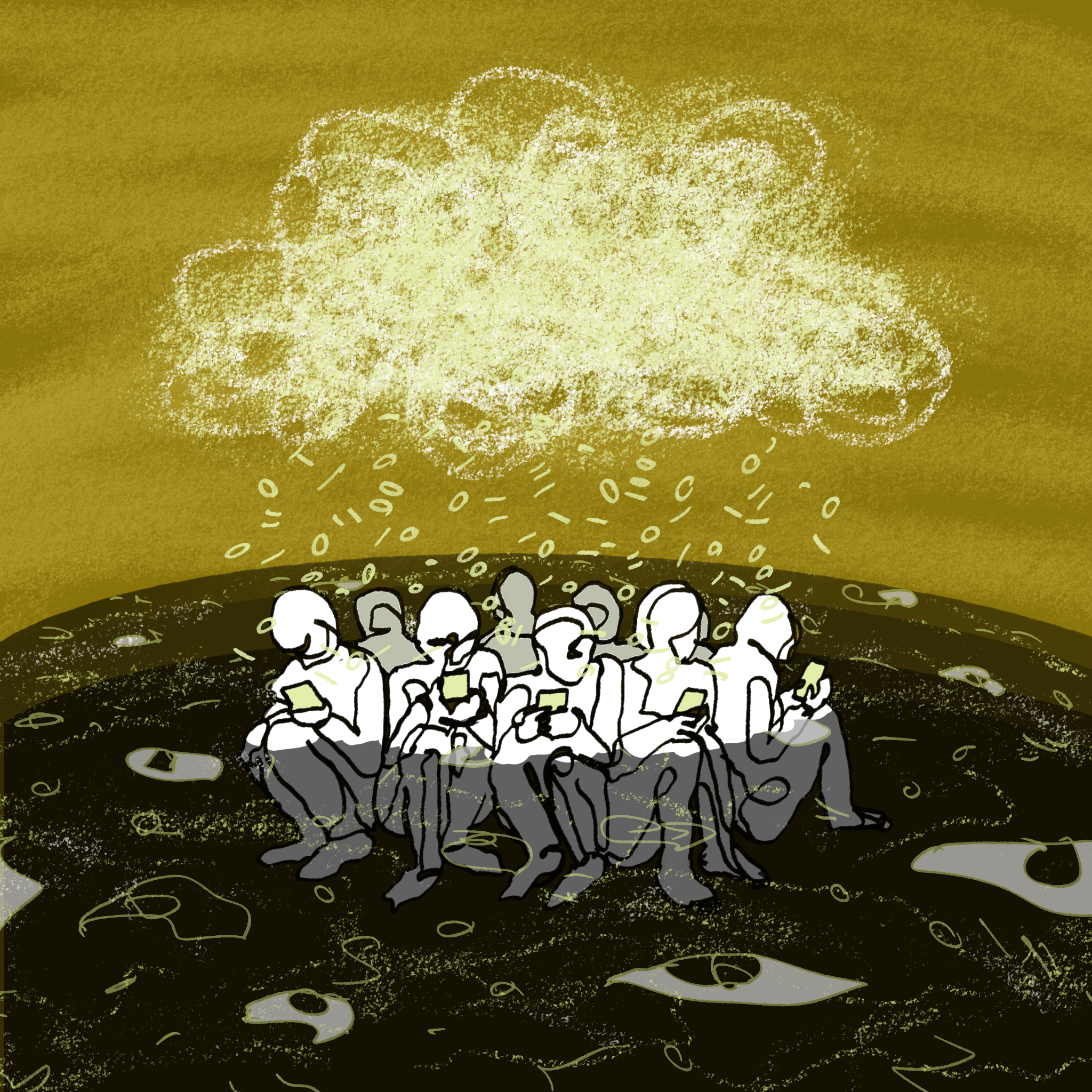
For global internet services such as Google, OpenAI, Meta or more specific technology providers (train ticket or media mobile applications) to be profitable, they require data collection (data economy). The more we use these services, the more they collect data from us. Hence they are designed to maximize the time each user spends on the app, captivating our attention (attention economy).
As a result, our personal data and our behaviour are tracked (surveillance economy) and sold to third-parties (companies, data brokers). These third-parties often work at the limit of legality and with great opacity. Finally, the accumulation of this behavioral data can influence our actions and decisions, both online and offline.
Additionally, data leaks due to negligence from providers can also foster online crime (see Scenario 4 below).
Finally, Artificial Intelligence (AI) systems – particularly generative systems – further increase the threat to our personal data. They depend on massive data collection: personal, and non personal. Thanks to their ability to process even more data, they can detect new correlations, allowing them to predict and steer behaviours with untold precision (intention economy).
More tracking for better profiling
Digital tools are ubiquitous in our daily lives. We live in an “information society”, where each of our actions leaves traces on the internet, on computers, smartphones, or any other connected devices. These traces can take up different forms;
- Likes / reposts
- Visited websites
- Search history
- Followed social media accounts
- Chats with an AI chatbot (e.g. ChatGPT)
- Whatsapp contacts
- Youtube history
- GPS localisation
- Online shopping history
- CCTV footage (in the street, in train stations, in shops…)
This information is either consciously provided by the user (us), or inferred from its behaviour. In some cases, this information allows companies to know us better than our parents, friends or partner !
This far-reaching data collection produces a personality profile ⤤ on each and every one of us. This profile consists in several thousand parameters regarding our:
- Interests
- Political Opinions
- Religion
- Sexual orientation
- Hobbies
- Marital status
- Contacts
- Shopping preferences
- Home and work addresses
This information can be bought or stolen, and can be used to influence us, as we will see below. IT is not necessarily linked to our identity, but it is not mandatory to have one’s name to exert influence on someone !
Références :
- Libération, article on PersonalData.io : «Les algorithmes se nourrissent de qui l’on est»
https://www.liberation.fr/forums/a-la-recherche-des-datas-cachees-20240205_6CD67Z5UD5GNVHJWN43XSBEMQY/ - inquiry FRC & Hestia labs : «1000 traceurs en 20 minutes: une société sous surveillance»
https://www.frc.ch/1000-traceurs-en-20-minutes-une-societe-sous-surveillance - TED, conference by Tristan Harris : How a handful of tech companies control billions of minds every day https://www.ted.com/talks/tristan_harris_how_a_handful_of_tech_companies_control_billions_of_minds_every_day
- New York Times, Your Apps Know Where You Were Last Night, and They’re Not Keeping It Secret: https://www.nytimes.com/interactive/2018/12/10/business/location-data-privacy-apps.html
- New York Times: One nation, tracked. An investigation into the smartphone tracking industry https://www.nytimes.com/interactive/2019/12/19/opinion/location-tracking-cell-phone.html
What does it look like in practice?
On the ground, this power to exert influence can take up different forms. The four following scenarios take inspiration from what is possible today. They can be fictional, but they can also refer to situations that really happened.
For each of the four scenarios, we provide below:
- a description
- the practical consequences for internet users / citizens
- examples
- some references
Scenario 1: Targeted advertising
Our personal data is sold by advertisers through data brokers. It is done through real-time bidding: the advertiser with the highest offer will be able to display its ad immediately, according to our personality profile.
The rise of generative AI enables far more effective profiling, not only because of the sheer volume of data collected, but also due to its nature: conversations with chatbots are often deeply personal, even intimate. This makes it possible to exploit cognitive biases and emotional profiles, which have always been the most powerful levers for influencing purchasing decisions.
Moreover, with companies such as OpenAI and Google rolling out ads in their AI chatbots, there are no guarantees that the actual ad and the answer of the chatbot will remain separated – as is the current promise of the companies. Considering what happened with social media and the amounts of money at stake, one could justifiably be doubtful.
Consequence: Influencing our shopping behaviours / displaying of unsolicited ads.
Examples:
- Aline searches for Jewish places of worship on Google. She also mentions on Instagram that she is single. The next day, she gives a professional presentation using the same computer. During the presentation, her browser displays an ad for a Jewish dating website. There is nothing wrong or shameful about this (she has “nothing to hide” !) yet she might not want this personal information revealed in that specific context.
- A 16-year-old girl shops at a supermarket and buys unscented cosmetic products. Through her loyalty card, the supermarket infers that she is pregnant and mails discount coupons for maternity items to her home address. Her parents had no idea she was pregnant (an actual case involving Target stores in the United States, 2012).
- AI Marketing: Nadia receives hyper-personalized recommendations from an e-commerce platform, based not only on her purchase history, but also on her browsing habits and real-time “emotional profile.” This makes her feel understood and valued, which, among other things, increases brand loyalty. In addition, the conversational agent she interacts with detects her specific emotional state and adapts its tone, recommendations, and responses accordingly, factoring in her recent social media activity as well.
References :
- Youtube, promotional video of Publicis by its Director General Arthur Sadoun, describing openly targeted advertising through massive data collection: https://www.youtube.com/watch?v=YCsE0VbH3vI
- Case of Target :
https://techland.time.com/2012/02/17/how-target-knew-a-high-school-girl-was-pregnant-before-her-parents/ - AI-augmented Marketing:
https://www.forbes.com/councils/forbescommunicationscouncil/2024/03/21/psychological-principles-in-ai-augmented-marketing/
Scenario 2: Influencing our offline life
Our personal data can be sold to states, institutions or private companies. The spread and evolution of technology (e.g surveillance cameras, “smart” glasses) allows them to extract and correlate (sometimes very sensitive) data, without the targeted person’s consent. This increases the surveillance of citizens, including with malicious intent.
Consequence: evolution of society towards less respect of privacy.
Examples:
- Eric is denied an insurance policy as well as a train ticket purchase on the SBB app. In fact, a credit agency had recorded a negative credit rating under his name due to late payments made by a family member who shares both his name and address.
Credit reporting agencies collect information on the creditworthiness and financial standing of individuals and businesses through multiple channels. - Élodie conducts academic research on Islamist radicalism, following affiliated accounts on X (formerly Twitter) for her work. When traveling to the United States for a conference, she is turned away at the border because of this suspicious digital footprint.
- A company Karim is applying to uses AI-powered recruitment software to screen applicants. The system gathers data from social networks and data brokers to build an “enriched profile” of each candidate.Mary is harassed and stalked by a police officer using automated license plate readers (ALPR) equipped with an AI system that alerts him to the real-time location of a targeted vehicle (an actual case that occurred in the US; see reference below).
- Eric is denied an insurance policy as well as a train ticket purchase on the SBB app. In fact, a credit agency had recorded a negative credit rating under his name due to late payments made by a family member who shares both his name and address.
References :
- Heidi News – Commerce des données personnelles via les data brokers :
https://www.heidi.news/explorations/razzia-sur-vos-data/qui-sont-ces-data-brokers-qui-s-arrachent-nos-donnees-comme-si-c-etait-de-l-or - Factsheet from the Federal Data Protection and Transparency Commissioner on the collection of creditworthiness data :
https://www.edoeb.admin.ch/fr/credit-et-encaissement - US border control :
https://www.courrierinternational.com/article/pratique-etats-unis-oui-les-douaniers-ont-le-droit-d-inspecter-les-telephones-et-les-ordinateurs_229157 - Faciale recognition (Clearview AI )
https://www.lemonde.fr/pixels/article/2024/09/04/l-entreprise-de-reconnaissance-faciale-clearview-ai-condamnee-a-une-amende-de-30-5-millions-d-euros-aux-pays-bas_6303912_4408996.html - AI in hiring:
https://privacyinternational.org/long-read/5798/humanless-resources-uncovering-ai-recruitment-software - Harassment of a woman by a policeman with the help of a license plate reader:
https://www.404media.co/footage-shows-cop-stalking-woman-he-met-on-a-tv-set-after-surveilling-her-with-a-license-plate-reader
Scenario 3: Political manipulation
During elections, personal data of citizens is used to send them targeted messages. These messages are targeted towards undecided voters to tip the scales in favor of a particular candidate.
Micro-targeted political manipulation is as old as the data economy (with the notable example of Cambridge Analytica, see below), but it becomes more subtle and – and as such, more efficient – with AI systems. These systems allow for massive disinformation campaigns on social media. Moreover, AI chatbots such as chatGPT increase the efficiency of potential manipulation by fostering informal and sometimes personal interactions with the user.
Consequence: Influencing election results.
Examples:
- Cambridge Analytica, election of Donald Trump in 2016.
- Use of disinformation by powerful states as part of hybrid warfare (e.g. Russia’s Portal Kombat)
References :
- Wikipedia on the Cambridge Analytica scandal: https://fr.wikipedia.org/wiki/Scandale_Facebook-Cambridge_Analytica
- The Great hack, Netflix documentary: https://www.netflix.com/fr/title/80117542
- Channel4 : Trump campaign strategy to deter millions of Black Americans from voting in 2016 https://www.channel4.com/news/revealed-trump-campaign-strategy-to-deter-millions-of-black-americans-from-voting-in-2016
- China : Political propaganda with AI:
https://armees.com/golaxy-comment-la-chine-mobilise-lintelligence-artificielle-pour-la-propagande-et-la-guerre-informationnelle/ - Arte: Taiwan, la GenZ sous l’influence de Pékin:
https://www.arte.tv/fr/videos/132515-000-A/taiwan-la-gen-z-sous-l-influence-de-pekin/
Scenario 4: Data breaches
Personal data stored by a third-party are stolen, and are at the disposal of cybercriminals. Data breaches happen almost every day in Switzerland most often through ransomware attacks (data theft followed by ransom demands): government data, hospitals, small towns, SMEs or critical organizations such as ICRC. Switzerland is a prime target because of its wealth and tendency to pay ransoms quickly to avoid reputational damage.
Consequence: Scams or identity theft.
Example: Alex shops on an e-commerce website that requires him to create an account and asks for unnecessary information (e.g., phone number, personal interests, employer). The e-commerce site gets hacked, and this information is used in a scam targeting his family or contacts.
References :
- Advice FRC :
https://www.frc.ch/comment-savoir-si-vos-donnees-ont-fuite-et-vous-proteger - CNIL memo on the risks of phishing and identity theft following a data breach:
https://www.cnil.fr/fr/conseils-fuite-vol-donnees - La Suisse est le 4ème pays le plus touché par les ransomwares
https://www.ictjournal.ch/etudes/2025-09-01/la-suisse-est-le-4eme-pays-le-plus-touche-par-les-ransomwares - Cyberattack ICRC :
https://www.rts.ch/info/monde/12801255-le-cicr-a-ete-victime-dune-vaste-cyberattaque-menacant-les-donnees-de-plus-de-500000-personnes.html - Communiqué de presse sur les cybermenaces, administration fédérale:
https://www.admin.ch/fr/newnsb/1qIx-8jjt9q5-qfFKHqCS

Conclusion and solutions / How to (re)act ?
The surveillance economy resembles a gigantic market of our personal data, which are the bedrock of our identity. But above all, it is about the power to influence our actions, decisions and behaviours. Despite this grim picture, the situation is not hopeless and many solutions exist.
The first one is to know that we still have a choice. The choice to use one of the wide range of privacy-respecting tools. Our page “Alternatives” ⤤ will be an invaluable guide to help you start your digital transition.
The second solution sits at the political and societal level. As citizens, we have the power to elect leaders that are sensitive to these problems and ready to defend our rights. We can also join or support associations that defend digital rights. In our own circles, we can spark dialogue, foster constructive debate on these topics, to allow as many people to learn more and help them defend their rights.
The data economy strives towards the categorization and individualisation of society, preventing the emergence of the commons. It is thus imperative to never forget the importance of collective action, of sharing and of solidarity, whether in this struggle or in others.