
ecology and digital
Digital technology, with its associated tools and services, has a very real impact on the environment ⤤ : resource extraction, soil pollution, waste, greenhouse gas emissions, etc., even though it is often considered immaterial through increasingly elaborate marketing formulations (clouds, virtual world, etc.).
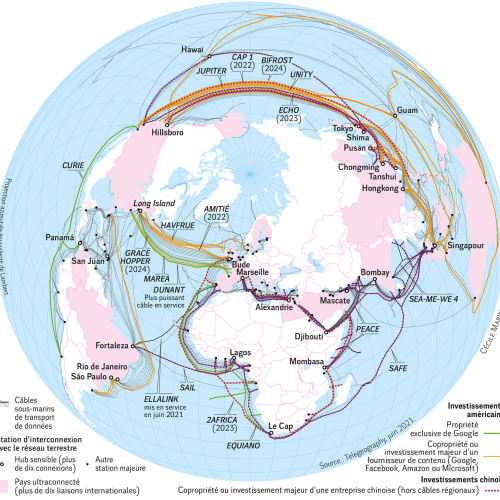
The Internet network is based on a colossal infrastructure of undersea cables (click here ⤤ for an interactive map). These cables form an integral part of a fierce battle between countries (led by the USA and China) and web giants such as Google, Amazon, Facebook and Microsoft, with major issues at stake in terms of sovereignty, security and intelligence.
What role does data play in all this?
Data drives digital technology. It’s information stored on physical devices (chips, servers, etc.) whose implementation, logistics and maintenance require colossal resources, particularly when it comes to cooling data centers. Without going into the technical details, this can be achieved in a variety of ways ⤤, using air conditioners, chilled water, immersion in a dielectric fluid, etc.
The aim of this page is to raise awareness of the ecological challenges of digital technology, in a way that complements our various projects ⤤.
The ecological issues related to digital technology are becoming increasingly important as it develops and is used more and more. It’s important to note that most of the negative consequences for the environment come from the manufacture of devices, and therefore from major industries.
The consequences are :
- Increased extraction of the mineral resources needed to manufacture digital equipment
- Soil pollution due to these extractions
- Increased energy consumption (logistical management of infrastructures, device recharging, etc.)
- Increased waste due to the programmed obsolescence of certain devices and/or incentives to consume new devices.


In order to make the most of the materiality of digital technology, and to contribute to reducing its impact, we propose a “digital life cycle” from the manufacture and use of your electronic devices to their recycling.
This cycle, detailed below, will help you reduce your ecological footprint and protect your personal data.
Far from being complete and perfect, the main objective here is to enable you to visualize and grasp both the impacts of digital technology (massive extraction of rare metals, water consumption ⤤…) and the existing alternatives.
1 | Manufacturing
- Buy refurbished devices (phones, computers, televisions, tablets, etc.).
- Choose an degoogled device ⤤ or install an degooled OS ⤤ .
2 | Use
- Use WIFI rather than 4G or 5G, which consume more energy.
- Download content (videos, podcasts) rather than use streaming services
- Use lighter services ⤤ (and more privacy-friendly!)
- Avoid charging your phone overnight to reduce battery deterioration and increase autonomy.
- Regularly sort your e-mails, photos and documents to reduce the space they take up on servers.
- Store data on an external hard drive
- Use applications and their tools (likes etc…) sparingly
- Avoid using ChatGPT or other generative AI for simple queries
- Favoring Progressive Web Apps (PWAs) ⤤ to conserve phone storage space and reduce data leakage linked to app downloads
3 | recycling
Solutions exist to enable you to donate or recycle your electronic equipment.
Conclusion ?
No click is harmless. The power of GAFAMS’ greenwashing ⤤ rhetoric is nothing but a decoy, and it’s crucial to guard against it.
Sorting, deleting data and using digital tools responsibly are all very concrete ways of positively impacting your digital carbon footprint.
Finally, as part of a fun and interactive awareness-raising approach, we invite you to discover and share “Trois-Rivières” ⤤, an action-adventure game lasting approximately 30 minutes and suitable for all ages 11 and up. Developed by Richard Hanna ⤤, the game deals with the environmental and social impacts of digital equipment manufacturing (mining, assembly plants, recycling plants) and the consequences of these industries on a village.
PS: Don’t hesitate to share this page with your friends and colleagues!